
“What was the budget last year?”
In most FMCG planning cycles, this is where the trade promotion conversation starts. It is also where much of the financial discipline quietly ends.
The question feels prudent. Last year’s number has been approved before. Sales has targets built on it, distributors expect a calendar, and the programs that “worked” are already lined up to return. Nobody has to defend a baseline that already exists.
That is exactly the problem. For many principals, trade spend is one of the largest costs they carry after cost of goods. Roland Berger estimates it can absorb as much as 30% of gross revenue, making it the second-largest line in the P&L for most consumer goods manufacturers. Yet it is often approved with less scrutiny than a capital request a fraction of its size. A new machine needs a payback case. A promotion calendar often needs only a precedent.
So before the number settles into next year’s plan, a CFO should ask a less comfortable question. What, specifically, did last year’s money buy?
Higher sales is not an answer
“Increase sales” sounds like an objective. To a finance team, it reads more like a description of a hope.
Consider three principals that all report a sales uplift during a promotion. The first gained new outlets that kept stocking the product after the offer ended. The second pulled next month’s orders into this month. The third filled its distributors’ warehouses while shelf movement barely changed. All three can show a chart that goes up. Only one of them bought something.
This is why the intended change has to be named before money is committed. If the goal is wider distribution, the proposal should state which outlets, why they would keep the product once regular terms return, and how that will be checked. If the goal is trial, the business needs a view of who should try the product and what would bring them back. If the goal is clearing seasonal stock, the cost should be weighed against the alternative of writing that stock down.
An objective that cannot be proven wrong cannot be evaluated either. It also gives Sales, Trade Marketing, and Finance nothing concrete to disagree about, which usually means the disagreement has simply been postponed to the claims stage.
Find what is actually holding the volume back
A sharper objective forces a harder look at why the volume is not already there.
Take an established product that sells whenever it is on the shelf. In some outlets it runs out between deliveries. In others it is stocked but hard to find. Elsewhere, owners have never carried it because they doubt local demand.
A blanket discount treats all three the same, and pays for all three. Yet only the third group has a problem that a price incentive is designed to solve. The first needs reliable replenishment. The second needs visibility. Funding a discount where the constraint is supply or placement is not an investment in growth. It is margin handed to outlets that would have sold the product anyway, had it been there.
This is where many trade budgets leak. Not through fraud or careless execution, but through programs aimed at the wrong constraint. A budget gains value only from how precisely it matches the opportunity it is meant to unlock.
Design for how partners will actually behave
A program also has to survive contact with the businesses expected to run it.
Distributors decide how much stock to allocate, where their salespeople spend time, and which outlets get served. Outlet owners weigh shelf space, stock rotation, and their own return. Every one of those decisions is made in the partner’s interest, not the principal’s. A design that ignores this will still be executed, just not in the way the plan assumed.
The rules matter for the same reason. If what qualifies for support, the period it covers, and the evidence required for a claim are left vague, the gaps will be filled later. Usually in the partner’s favor, and usually at settlement, when the principal has the least leverage. Ambiguity at launch tends to resurface months later as a disputed claim, or as a deduction Finance cannot trace back to any agreed activity.
Changes during the program carry the same risk. A delayed shipment or an extended period alters both the result and the cost. If those changes are not confirmed while the program runs, the principal ends up negotiating the facts after the money is already owed.
Set a limit the incremental result can carry
The financial question should come last, but it has to be answered honestly.
How much additional contribution can the program reasonably generate, and how much is the principal willing to give up to get it? Answering that requires an estimate of what would have sold without the offer. Without a baseline, every unit sold during the promotion looks like a result of it, and the return looks better than it is.
The cost side deserves the same rigor. Discounts, agreed execution support, and eligible claims should be counted in full and counted once. Claims that arrive late still belong to the program that caused them, even when they land in a different period.
Then there is the question of how much money is actually still free. Earlier programs and open claims may already have committed part of the budget, even if the invoices have not arrived. A principal that cannot see those commitments alongside a new proposal is not deciding how much to invest. It is guessing how much it has.
Where uncertainty is high, such as a new territory or a new channel, a smaller first commitment is not timidity. It is the cheapest way to buy evidence before buying scale.
Decide in advance what would justify funding it again
A defined objective gives the post-program review a standard to meet, rather than a story to tell.
A program meant to clear inventory can be judged on stock reduced and the cost of each unit cleared. A program meant to build distribution needs a longer view: what participating outlets do after the offer ends, not during it.
The review should also ask where the volume came from. Was it genuinely new demand, purchases pulled forward from the following weeks, stock sitting in the distribution pipeline, or sales shifted from another product in the same portfolio? And what margin was left once every cost was counted?
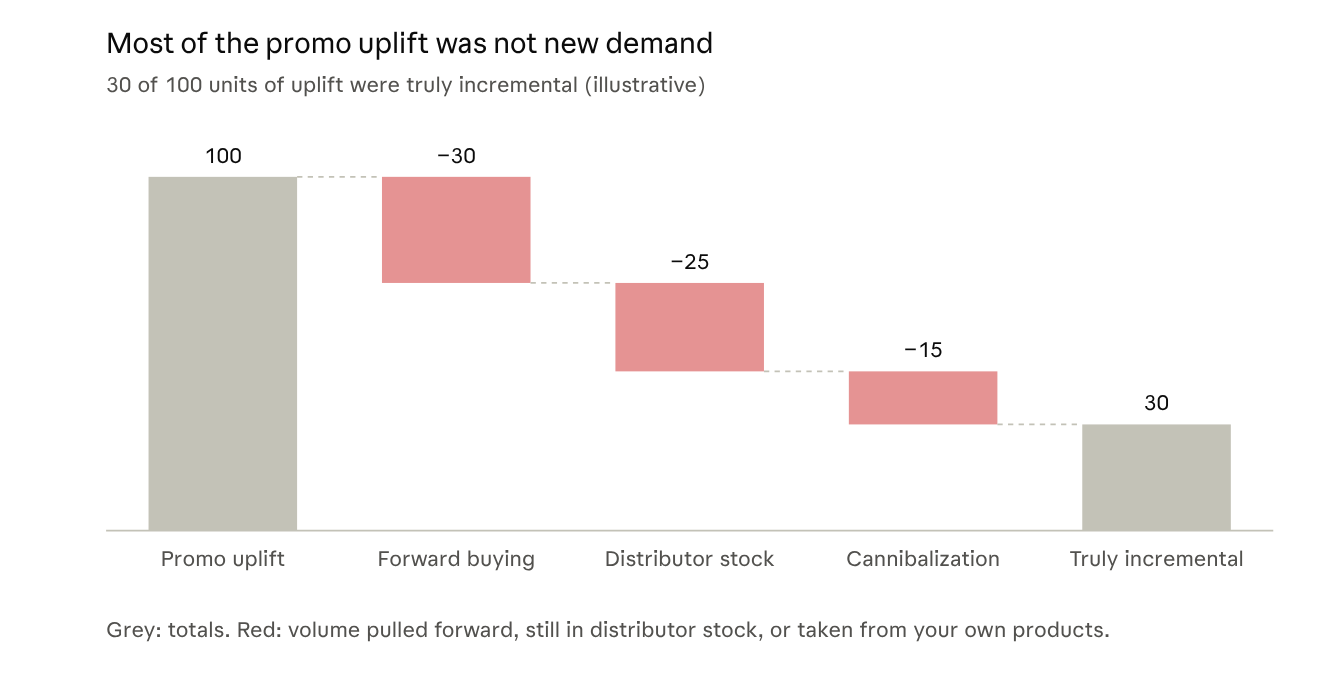
These questions are uncomfortable because the answers are often less flattering than the uplift chart. That is precisely why they are worth agreeing on before the program starts, not after.
For me, this is what separates spending on trade promotions from investing in them. Investment leaves the organization better able to decide what to fund next. Spending only leaves a new baseline for next year’s request.
So before debating whether next year’s budget should be larger, one question deserves an answer.
What result would make this year’s investment worth making again, and what result would make you stop?
If your team cannot answer that yet, the question may deserve a place on the agenda before next year’s number does. At Pratesis, it is usually where our conversations with principals about trade promotion begin.
Ready to talk with our team?
Tell us what you are working on. We will help you find the right place to start.