Picture an AI agent that handles replenishment for a distributor, working straight from the company’s master data. It works at three in the morning and it never gets tired. One night it orders 400 cartons of a product that shows zero stock.
Its reasoning is flawless. The trouble is that the same product sits in the system under three different codes, and two of them still have stock in the warehouse.
Nobody typed a wrong number. The agent did exactly what the data told it to do. A human planner would have paused and said, “Wait, I saw that product on the rack yesterday.” The agent did not pause because nothing in the data gave it a reason to.
The Shortcut Everyone Wants
An attractive idea is going around boardrooms. If AI agents can sit on top of our systems and do the work, why spend money fixing the core? Keep what we have, and let the agents work around it.
I understand the appeal. Modernizing a core system is slow, expensive, and rarely anyone’s favorite project. McKinsey puts the cost of an ERP migration for most large enterprises between $100 million and $1 billion. Smaller companies pay less, but it hurts just as much.
The same McKinsey article asks whether a “good enough” backbone with agents on top could be the future, and concludes it is unlikely. I agree. My reason is less about architecture and more about something every operations person already knows.
We Have Run This Experiment Before
About a decade ago, robotic process automation made a similar promise. Software robots would click through the old screens for us, and the old systems could stay.
The quick wins were real. So were the leftovers. Duplicate customers, inconsistent price lists, and approval steps nobody could explain all stayed exactly where they were. The robots made a messy process run faster. McKinsey describes RPA as a cautionary precedent for this reason: the gains came at the edge, and the problems stayed in the core.
Agents are far more capable than those robots, and that is what should worry us. A robot that meets unexpected data stops and waits for a person. An agent improvises.

Your Master Data is Held Together by People
In most companies I have seen, the system does not keep master data correct. People do.
There is the admin who knows that two customer codes are really the same shop. There is the warehouse lead who knows the unit conversion for one supplier is wrong and fixes it in his head every single time. None of this is written anywhere. It works because a person stands between the data and the decision.
Agents remove that person. That is the whole point of them. But every quiet correction leaves with the person, and an agent cannot know what was never written down.
AI does not fix your data. It trusts it.
So the useful question for a leader is not how smart the AI is. It is how much of the truth about your business lives only in someone’s memory.
Why I Put AI Last
When I look at any transformation, I look at five things: people, process, data, technology, and AI. I put AI last on purpose. It is not the least important. It depends on all the others.
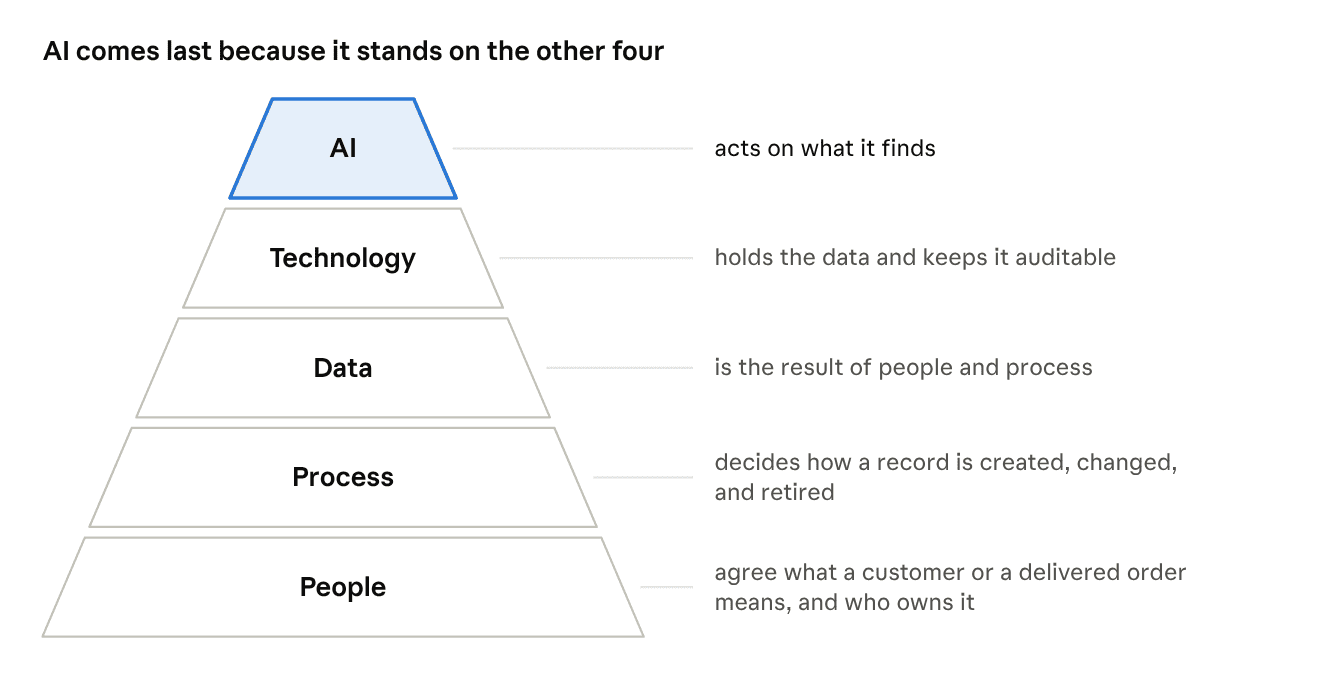
Reverse the order, and you get speed without trust.
This is also why I do not treat master data as an IT problem. Duplicate customer codes rarely come from bad software. They come from sales and finance never agreeing on who can create a customer. Master data is an agreement between people, and no agent can make that agreement for you.
The Work Nobody Wants to Own
It is tempting to treat this as a clean-up project, with a scope, a budget, and an end date. I have come to see it as something smaller and less comfortable.
Smaller, because one flow is enough to learn from. Take replenishment, or order-to-delivery, and ask the people who run it what they correct by hand. Their answers describe the business more honestly than any system documentation I have read.
Less comfortable, because that list tends to be longer than management expects, and some of the corrections exist because of decisions we made ourselves. A price exception we approved once and never recorded. A customer we let two teams register in two different ways.
What the list really shows is not dirty data. It shows where ownership is missing. Somebody has to be allowed to say “this is the correct record,” and in many companies nobody is. Until that question has an answer, I would hesitate to let any agent act alone.
This work is not glamorous. Nobody gets promoted for merging duplicate product codes, which is exactly why it stays undone.
The Excuse is Getting Weaker
The same research offers good news. McKinsey estimates that AI agents could cut the effort and duration of ERP programs by at least half. If that holds, cleaning the core will soon cost much less than it used to, and “too expensive” becomes a harder excuse to keep.
But notice what that help covers. Agents can speed up the cleaning. They cannot decide who owns the record.
So I do not see a choice between fixing the core and adopting AI. The first is the entry ticket for the second.
Think again about the agent ordering 400 cartons at three in the morning. It was not a bad agent. It worked with what we gave it.
If an agent started making decisions from your data tomorrow morning, what would it get wrong that your people quietly get right today?