

Building a More Capable Business, Not Just a More Digital One
Artificial intelligence is expanding what technology can understand, decide and act upon. But the fundamentals of business transformation remain the same: People, Process, Data and Technology.
The real opportunity is not simply to introduce more AI, but to build a business that can see more clearly, decide with stronger context and act with greater confidence.
Business transformation has entered a new phase.
For years, transformation programmes have focused on digitising processes, integrating systems, improving data access and giving people better tools. Those priorities remain important.
What is changing is the capability of technology itself.
AI can interpret information, identify patterns and support decisions. Agentic AI extends this by allowing systems, within defined boundaries, to participate in workflows and take actions on behalf of an organisation.
This creates a different leadership question.
It is no longer enough to ask: Where can we add AI?
A more useful question is: What should the business become better able to do, and where can AI meaningfully strengthen that capability?
Greater technological capability does not automatically create greater business value. Leadership must still decide where autonomy belongs, what risks accompany delegation, and what outcome should improve.
The opportunity is not simply to become more digital. It is to become more capable.
The Foundations Have Not Changed
AI changes what technology can do. It does not change the fundamentals of transformation.
People, Process, Data and Technology remain the foundation. AI and Agentic AI can strengthen them, but they do not replace them.
People remain responsible for purpose, judgement and accountability.
Process remains critical because a poorly understood workflow does not become a good workflow simply because parts of it can now be automated.
Do not automate confusion.
Data must be trusted, accessible and governed. Poor data can produce poor recommendations, and when AI is allowed to act, it can turn a data problem into an operational problem.
Technology also remains essential. Integration, identity, access control, cybersecurity and monitoring become more important as systems gain greater ability to act.
AI does not remove weak foundations. It can amplify their consequences.
Not Every Process Needs an Agent
There is a broad progression from conventional automation toward increasingly autonomous systems:
Automation → Assistant → Copilot → Agent → Controlled Digital Worker
The terminology may vary. What matters is the degree of discretion and authority given to the technology.
Three questions should guide the choice:
Is the process mature enough?
Will greater intelligence or autonomy create meaningful business value?
What happens when the system is wrong?
The most autonomous solution is not necessarily the most mature solution.
Agentic capability should not advance faster than organisational capability.
The objective is not to maximise autonomy. It is to apply the right degree of autonomy to the right work.
AI Adds Intelligence and Action
A useful way to think about AI is as an intelligence and action layer around existing people, processes, data and enterprise systems.
Traditional systems record transactions and execute defined workflows. AI can help interpret information, identify patterns and generate recommendations. Agentic AI adds the ability to use that intelligence to participate more directly in a workflow.
The distinction can be expressed simply.
Automation asks: When this condition occurs, what predefined action should follow?
Agentic AI can ask: Given the objective, available information and defined boundaries, what should happen next?
This can shorten the distance between:
information → understanding → decision → action
Capability and Governance Must Grow Together
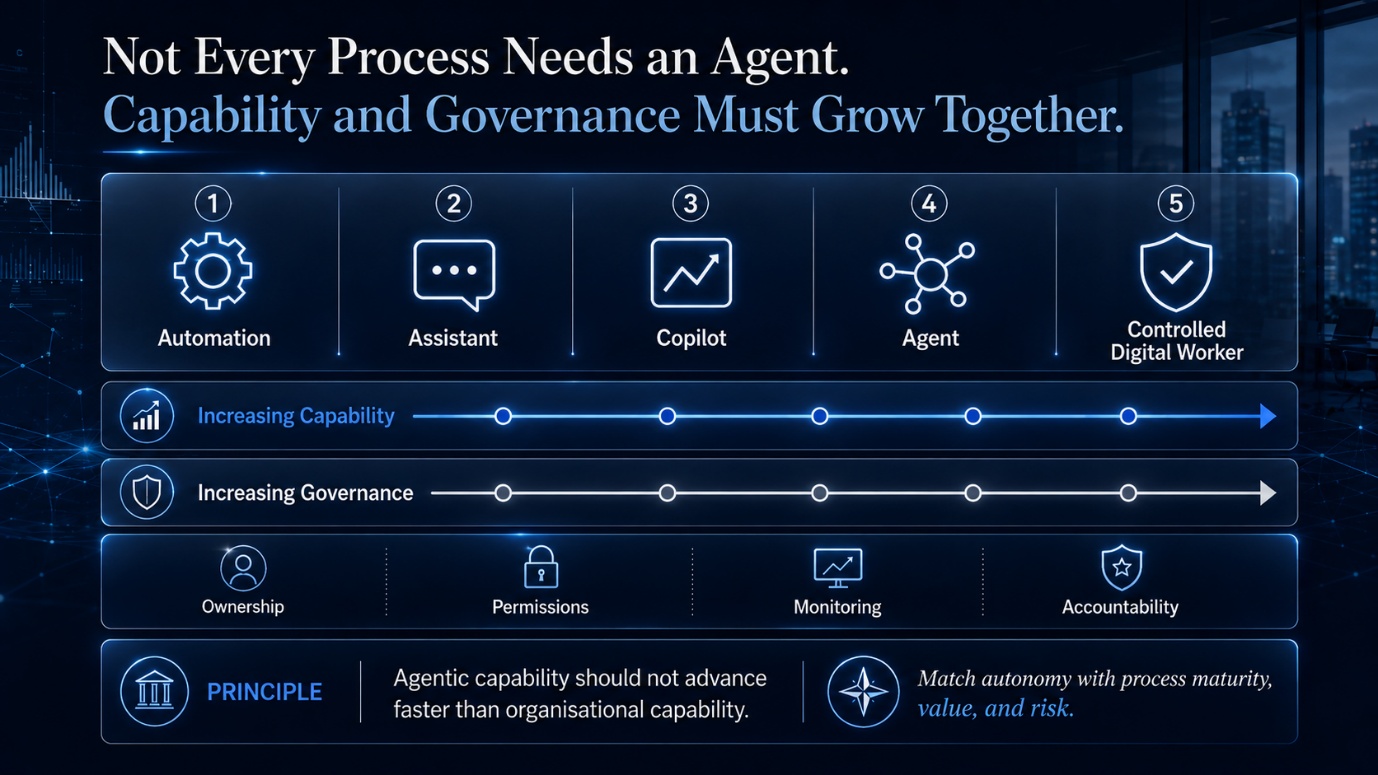
When AI moves from assisting people to performing actions, leadership is effectively delegating authority.
The practical questions are:
Who is the system acting for?
What can it access?
What actions is it allowed to perform?
Can the organisation see what it did?
Who remains responsible for the outcome?
The greater the authority delegated to AI, the stronger the requirement for process maturity, ownership, controls and accountability.
Human oversight should reflect consequence. Low-risk, reversible activities may suit automated execution with monitoring. Financially material, customer-sensitive or difficult-to-reverse actions may require explicit human approval.
Governance should be designed into the capability, not attached to it later.
Where AI Can Make the Business More Capable
AI becomes valuable when it improves an outcome that already matters to the business.
It can help organisations understand faster, decide earlier, execute more consistently and preserve organisational knowledge.
For leaders, the questions remain familiar:
What decision becomes faster or better informed?
What process becomes more reliable?
What capacity is increased?
What cost or risk is reduced?
What customer or operational outcome improves?
If these questions cannot be answered clearly, greater AI sophistication may not yet be justified.
How to Begin
The starting point does not need to be enterprise-wide.
A disciplined approach is:
One problem. One process. One owner. One measurable outcome.
Diagnose → Design → Develop → Deploy → Measure & Improve.
Begin with the business problem and establish a baseline. Define the future process before deciding how much AI should participate. Introduce only the required capability, then measure outcomes such as cycle time, productivity, cost, accuracy, service level or risk.
If the organisation becomes measurably more capable, expand deliberately.
The Destination Is a More Capable Business
The AI conversation can easily become dominated by models, platforms, copilots and agents.
They matter, but they should not become the purpose of transformation.
The better leadership question is:
What should the organisation become better able to do?
A more capable organisation should see important changes earlier, apply knowledge more effectively, decide with stronger context and respond with greater confidence.
The measure of AI maturity may therefore not be how many agents an organisation deploys.
It may be how effectively the organisation can delegate action while retaining control, accountability and business purpose.
Technology will continue to change. The fundamentals of transformation will endure.
The greatest opportunity is not simply to bring more AI into the business. It is to make the business more capable through AI.
Discuss Your Transformation Journey
If you are exploring where AI or Agentic AI can create meaningful business value within existing processes, data and technology, the starting point does not have to be the technology itself.
It can begin with a business problem, a process and an outcome worth improving.
We would be glad to discuss the journey with you.


