Before you split the budget, ask which products, channels, and outlets actually need a push.
Every quarter, the promo plan follows a familiar logic. The best-selling SKU gets the largest share of the budget because it is the safest bet. Volume rises, the target is achieved, and the report looks good.
One question rarely gets asked: how much of that volume would have been sold without the promotion?
Take a store that normally orders 10 cartons a month. During the promo, they order 14. The following month they are down to 6. Over the two months, they have bought precisely what they would have bought otherwise. In this example, the promo moved the timing of the purchase rather than adding to it, and the company paid a discount on every carton.
Why the best-seller always gets the budget
The logic is understandable. A best-seller makes the targets much easier to hit. Distributors ask for it because it moves. For the sales team, it carries the least risk.
The problem is how we measure success. Most promotions are judged on volume over the period, not on what they actually added. Under that scorecard, the sensible thing to do is always to fund the product that is already selling, regardless of how little new ground it actually covers.
This is not a people problem. It is a design problem. The scheme is asking “how much did we sell?” rather than “what did we change?”
The missing question: what should this promotion change?
A promotion is worth paying for when it changes something that would not change on its own. For example:
- An outlet places its first order.
- An outlet which stopped ordering comes back.
- A SKU enters stores that do not carry it yet.
- An outlet will try a new variant or pack size.
- The brand is up against a competitor’s drive for shelf space.
- Aging stock clears prior to it expiring.
If no one can name the change, the promotion behaves more like a discount than an investment.
Lens 1: The role of each product
Not all products in the portfolio are equal in terms of their role, so not all products require the same level of incentive.
- Hero products generate the traffic and volume. They usually sell on their own.
- Growth products have room to expand distribution or attract new customers.
- New products need a trial and a first order.
- Mature or slow-moving products may need help clearing stock and defending shelf space.
For a best-seller, a promotion makes the most sense in two circumstances: defending against a competitor, or opening up outlets that do not carry it yet. Adding volume to outlets that already buy it every month is rarely one of those two.
The economics in Indonesia really drive this home. In the shampoo category, NielsenIQ data shows that packs at IDR 500 and IDR 1,000 account for over 90% of the volume. The best-seller is the low-priced, thin-margin pack that consumers buy regardless of price. A discount therefore will quickly eat into margin with no change in behavior.
Lens 2: The role of each channel
Traditional kiosks and markets were 67% of FMCG sales in Indonesia in Q1 2025 (Kantar). Modern trade is smaller but still growing, and promotions are very important in minimarkets.
The same incentive behaves differently across these channels:
- Wholesale (grosir and semi-grosir): a discount can lead to stockpiling or flow to other areas far from the intended outlets.
- Small stores: the mechanism has to be simple enough to actually reach the store owner.
- Modern trade: the promotions compete against the listing fees and the retailer’s own promo calendar.
- B2B ordering platforms: the incentive can be targeted precisely, but only if the outlet data behind it is clean.
A scheme designed for one channel and then copied across all of them produces very different outcomes, most of which nobody intended.
Lens 3: The role of each outlet group
Indonesia still has around 3.9 million warung kelontong, according to the Indonesian Street Vendors Association (APKLI). They do not behave alike. Even a simple grouping would show where the money goes:
- Large outlets that order regularly
- Active outlets with small volumes
- Outlets that have stopped ordering
- Outlets not yet covered
In many schemes, the biggest share of the incentive goes to the first group. These outlets need it the least. They easily clear their volume thresholds so they get the reward for buying what they already buy.
Putting the three lenses together
The same product will in fact require different decisions in different places.
| Product role | Outlet group | What the promotion should change | How to measure it |
| Best-seller | Large, regular outlets | Usually nothing; a price promotion is rarely needed | Baseline holds without a discount |
| Best-seller | Outlets not carrying it yet | A first order | Number of new outlets selling the SKU |
| Best-seller | Outlets that stopped ordering | Reactivation | Outlets still ordering in the months after |
| New product | Active outlets | Trial | Repeat orders after the promo ends |
| Mature product | Outlets with aging stock | Stock clearance | Days of stock before vs. after |
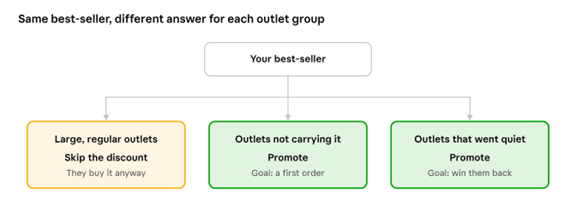
Best-sellers can still be promoted, as long as it happens where a promotion can actually change something.
Four questions before approving the next scheme
Companies that perform well on trade investment all share one thing in common: they use more granular data to differentiate their incentives by customer rather than apply a single rate to all customers. In practice, that translates into four questions.
- What is the baseline per outlet and per SKU? Regional totals are not enough. Without an outlet-level baseline, new volume and volume that would have happened anyway are hard to separate.
- What happened after the promotion had ended? If orders had fallen below normal then part of that uplift had been taken from the following month.
- Where did the money land? What share of the budget went to outlets that would have bought it anyway?
- What change was this scheme meant to buy? State it prior to launch and then measure it post-launch.
All four are based on the same thing really: secondary sales from distributor to outlet, visible outlet by outlet under one clean outlet ID. This is where duplicate and ghost outlets come back into the picture. If the outlet list is wrong, then every baseline that is built on it is going to be wrong.
Volume is easy to buy. Change is not.
The promotions that pay back are usually the ones built around a specific change, not the biggest volume. One question is worth asking before the next scheme goes out: what would retailers have bought without it? That part rarely needs a discount.
How much of your last promotion actually paid for sales you already had? Pratesis helps principals and distributors see secondary sales outlet by outlet so each scheme can be planned against a real baseline and assessed in terms of what it actually achieved.
Ready to talk with our team?
Tell us what you are working on. We will help you find the right place to start.