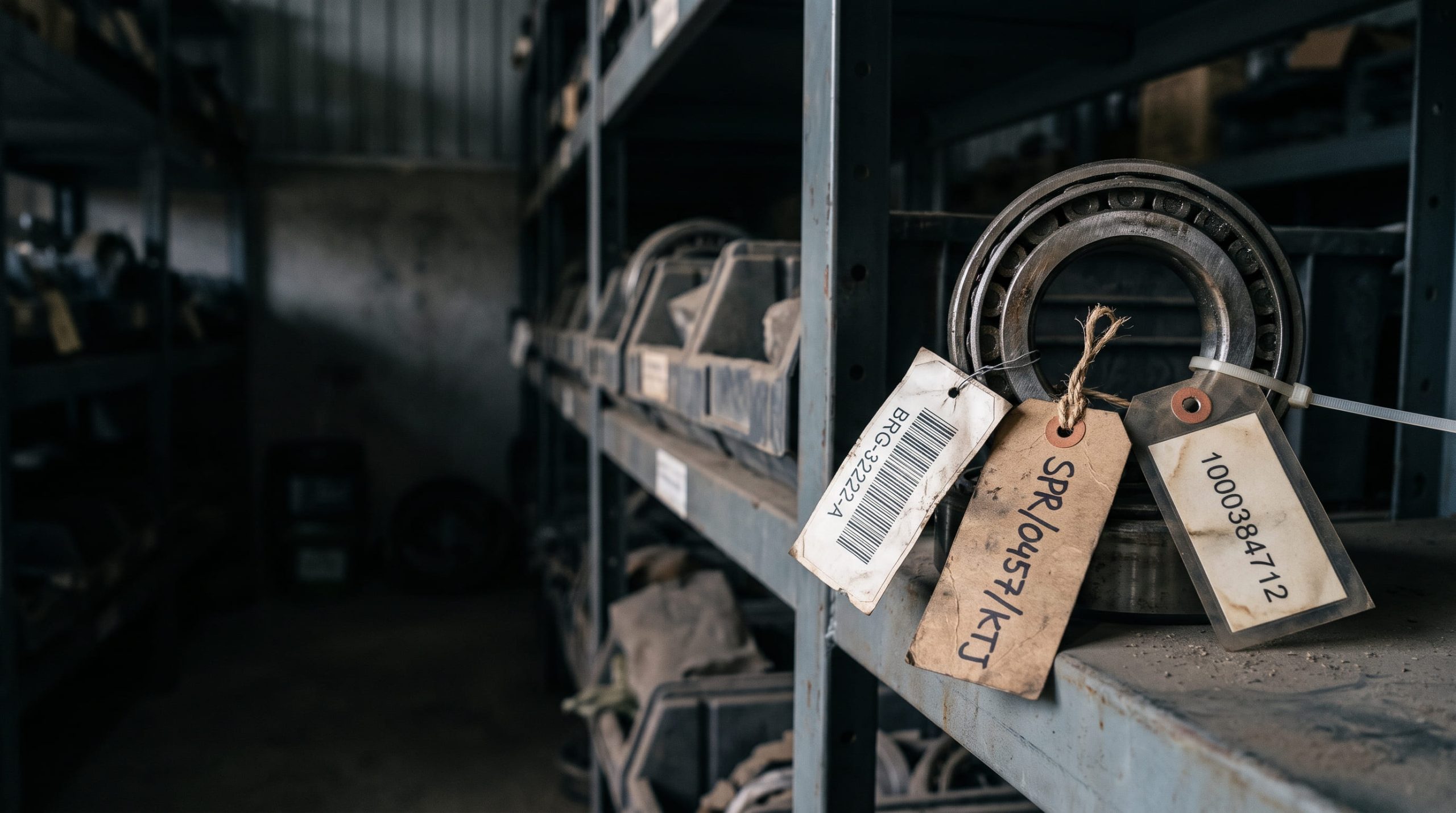
When a global metals company took a close look at its maintenance purchasing, it found hundreds of item codes for the same physical parts, each bought at very different prices. After matching those codes, it cut its overall MRO spend by 20 percent, according to McKinsey.
Picture 2 a.m. at the pit. A haul truck is down with a failed wheel bearing. The system shows zero in stock, so an emergency purchase goes out and the truck waits. Two weeks later, a stock count finds 14 of the same bearing on a shelf, registered under a different code. A third code for the same part sits at another site.
Nobody made a dramatic mistake. The system simply had three names for one part, and on that night it gave the wrong answer.
How one part becomes three codes
Duplicates rarely come from carelessness. They build up through everyday work, often under time pressure:
- Multiple sites, multiple habits. One site writes “BEARING, ROLLER, TAPERED”, another “Bearing taper 32222”, a third uses only the OEM part number.
- OEM versus supplier numbers. The same component bought from the manufacturer and from a distributor ends up with two codes.
- Free-text descriptions. Spelling, abbreviations and a mix of English and Bahasa Indonesia make one item look like several.
- Migrations and acquisitions. Each new system or site brings its own item master, loaded rather than reconciled.
- When a machine is down and the search returns nothing, creating a new code feels faster than looking harder.
McKinsey describes most MRO datasets as “extremely messy”, with duplicate orders that trace back to inconsistent naming and taxonomy.
Where the cost actually shows up
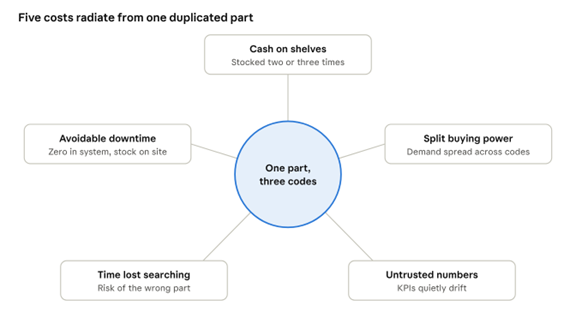
Every duplicate code feeds the same five costs.
Cash sitting on shelves. Each code tends to carry its own safety stock, and when stock under one code cannot be found, the part is bought again. Holding that excess typically costs around 20 percent or more of its value per year. As an illustration, a mining group spending Rp 500 billion a year on MRO with a 5 percent duplicate purchase rate spends Rp 25 billion on parts it already owns.
Downtime that did not need to happen. The work order is open and the mechanics are ready, but the unit waits for parts that are physically on site. Mean time to repair (MTTR) goes up and physical availability (PA) goes down. When one haul truck or crusher holds up the production chain, a few hours of avoidable downtime can cost many times the price of the part.
Buying power split into pieces. One part’s demand is split across three codes, so procurement negotiates three small volumes instead of one large one. Purchase requisitions go out for parts already in stock, often as emergency orders with premium freight, and the same need can sit in the budget as both an open commitment and an actual cost.
Time lost searching. Planners and storekeepers hunt through near-identical records, and when two similar records hide slightly different specs, the wrong part gets issued and the job is redone.
Numbers nobody can fully trust. Every part issued should land on a work order, an asset and a cost code. When one bearing lives under three codes, its usage and price history are split, so parts cost per asset and unit cost per BCM or per ton become harder to explain. Gartner estimates poor data quality costs organizations an average of USD 12.9 million a year; in a mine, much of it hides in the item master.
Why one-time cleanups do not last
Many companies have run a master data cleanup. The numbers improve, and within a year or two the duplicates are back. Cleanup treats the symptom: if the way codes are created does not change, the same pressures rebuild the problem.
What fixing it actually looks like
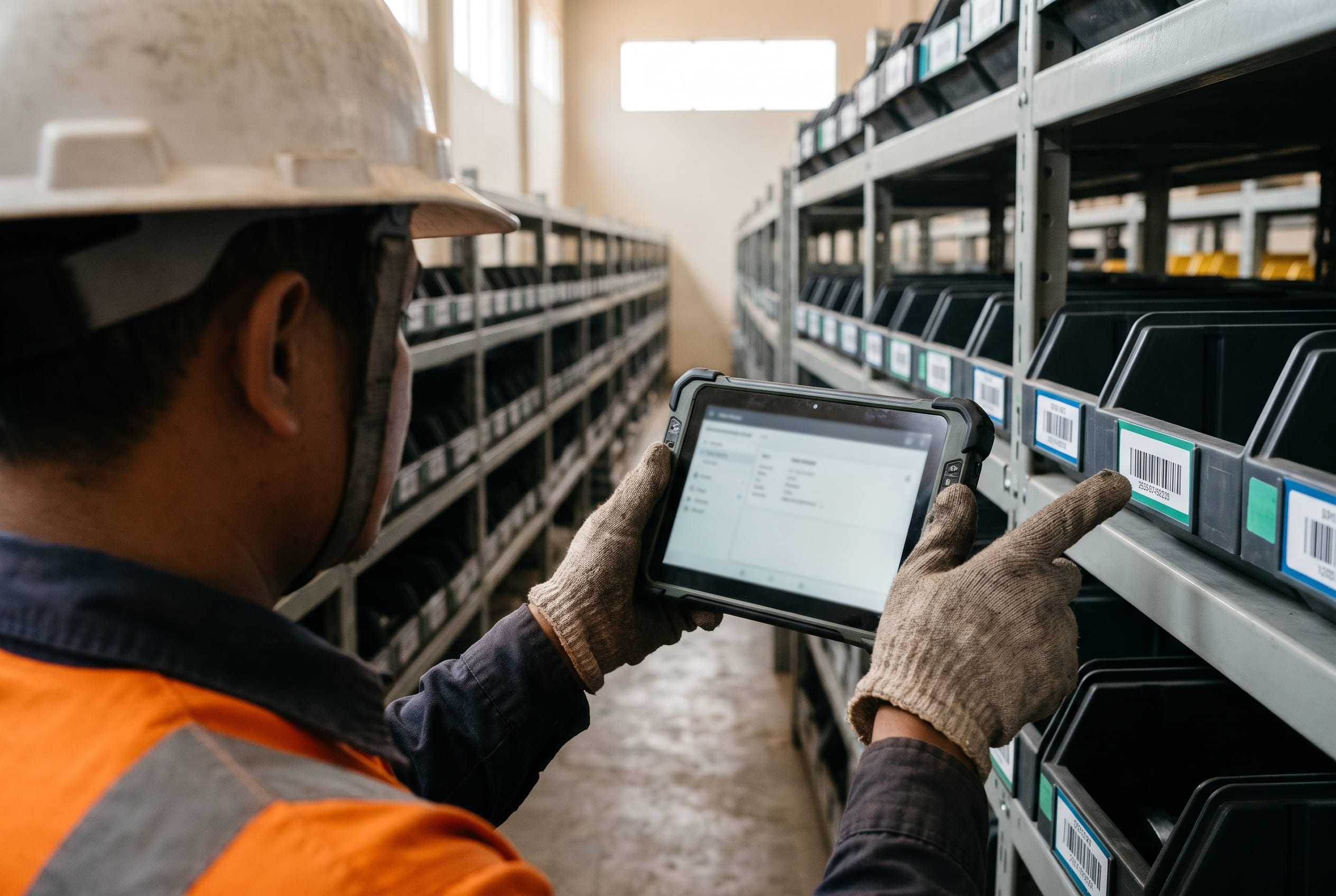
Fixing duplicate master data is less about a tool and more about treating the item master as a shared asset:
- A clear owner accountable for the material master across all sites.
- One naming standard: noun, modifier and key attributes, controlled abbreviations, one agreed language.
- The manufacturer part number as an anchor, checked before any new code is created.
- One request path for new codes, with a duplicate check and approval, including urgent requests reviewed afterwards.
- An ERP that enforces the rules: mandatory fields, validation and one item master shared by every site.
- A number to watch: the duplicate rate and the new codes created each month.
The payoff is real. In a case documented by Deloitte, a global mining company that brought its MRO inventory under control cut maximum stock targets and reorder points by more than USD 25 million, and an early test found another USD 14 million in savings from canceling purchase orders it did not need.
Five questions to test your own item master
- Which parts costs are hardest to trace back to a work order, an asset and a cost code?
- If we search by manufacturer part number, how many parts appear under more than one code?
- Who can create a new item code, and how long does it take?
- Do all our sites share one item master?
- When a unit breaks down, does more time go into the repair, or into waiting for parts?
The bottom line
Duplicate master data rarely looks like a crisis. It shows up as a part bought twice, a truck waiting a few extra hours, a contract negotiated on half the volume, a report that is slightly off. Added up across sites and years, those small leaks become one of the most avoidable costs in a mining operation.
The fix is not another cleanup project but shared discipline: one owner, one standard, one way to create a code, and a system that makes the right way the easy way. One part, one code. For a mine that counts every hour of uptime, it is one of the most practical places to start.
How many duplicate codes are hiding in your item master?
Pratesis helps mining companies build one clean item master across every site, and the ERP processes that keep it that way. Start with a discovery session with our team, and bring one recent breakdown or one hard-to-trace cost. We will trace it through your data together.
Ready to talk with our team?
Tell us what you are working on. We will help you find the right place to start.