
Innovation Isn’t a One-Off—It’s a System
Most companies celebrate innovation as a moment: a great idea, a successful pilot, a breakthrough result at one site. But in any industries, lasting advantage comes not from isolated wins—but from the ability to repeat them across the enterprise. Innovation is not an accident. It’s a system. And building that system is the board’s responsibility.
When Innovation Stalls at the Site Level
We’ve all seen it—a site leader designs a better fuel tracking process, or a planner automates part of the maintenance schedule. But without enterprise architecture, documentation, or system support, the idea dies locally. Worse, it may conflict with corporate systems or compliance rules. Innovation becomes isolated, not institutionalized. Without intentional replication structures, great ideas go unshared and underleveraged.
Leadership Must Shift from “Greenlight” to “Govern”
Boards often view innovation as something to fund—approve the budget, greenlight the pilot. But governance requires more: ensuring there’s a pathway from concept to rollout. That means investing in frameworks for validation, scalability, and change management. It also means defining thresholds: Which innovations qualify for enterprise adoption? How do we manage risk during rollout? Governance must move from occasional support to ongoing stewardship.
Platform Thinking Over Project Thinking
Organizations that treat every innovation as a project end up with dozens of disjointed initiatives. But those that build platforms—common data models, unified ERPs, modular workflows—enable reuse and adaptation. When one site configures a dashboard or automation successfully, others can adopt with minimal rework. Platform thinking creates velocity. Boards must champion architectures that make innovation portable. For more insights, see rethinking governance for digital innovation.
Innovation Must Serve the Operating Model
Not all innovation is helpful. Some pilots disrupt more than they improve. Boards must ensure that innovation aligns with core business goals: safety, uptime, cost efficiency, and capital allocation. This means defining what success looks like and requiring measurement at every stage. A good idea that doesn’t scale, comply, or deliver value isn’t strategic—it’s a distraction. Disciplined innovation is value-driven. See how innovation governance with RACI model supports decision-making.
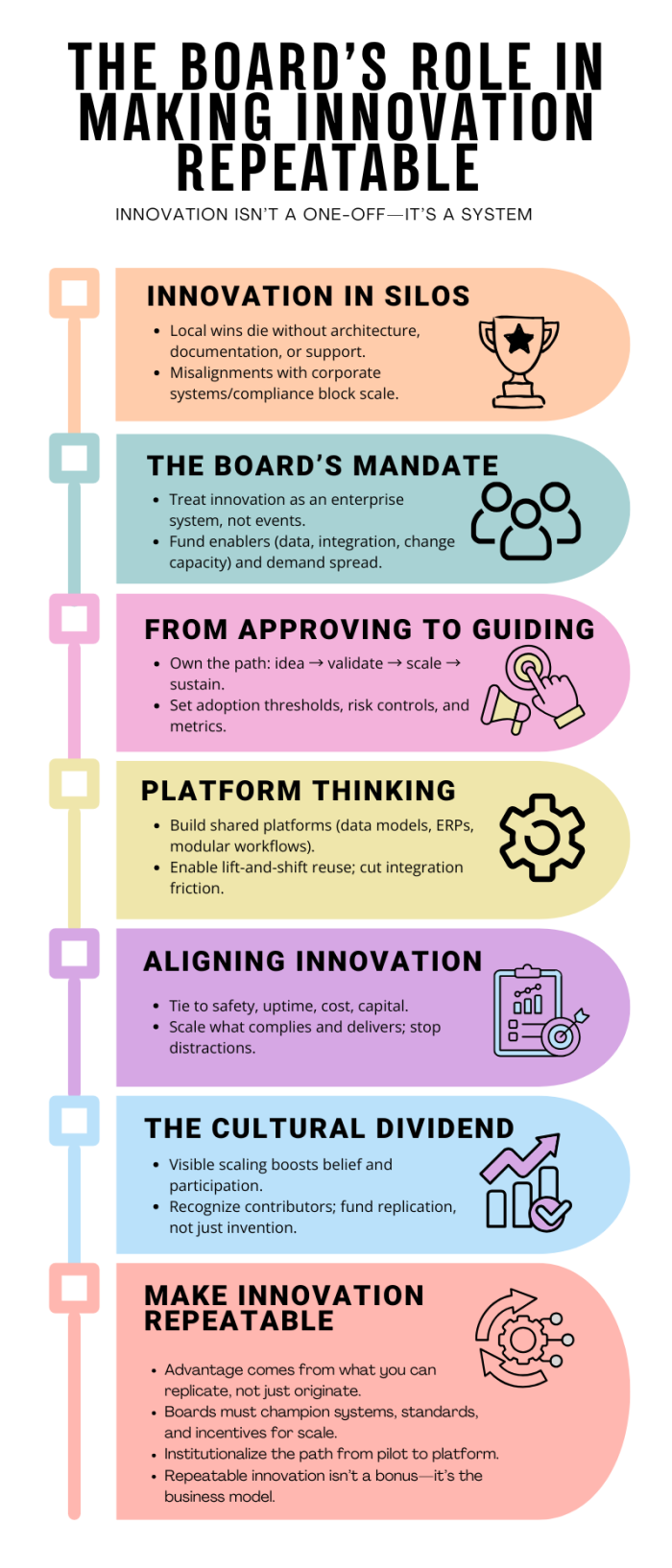
The Cultural Dividend of Scaled Innovation
When teams see that their ideas can scale, engagement spikes. People invest in improvement not because they were told to—but because they believe it matters. Innovation becomes a source of pride and shared progress. Boards that create visibility, recognition, and funding for scaled innovation help build a culture of enterprise-wide problem solving. Learn more about transformative governance of innovation ecosystems and explore agile governance frameworks for organizations.
Make Innovation Repeatable, Not Remarkable
Your best competitive advantage isn’t the innovation you celebrate—it’s the innovation you scale. Boards must lead the charge in creating systems, standards, and incentives that make innovation a repeatable engine of enterprise performance. In a world of increasing complexity and narrowing margins, repeatable innovation isn’t a bonus—it’s a business model. For guidance, read about innovation governance in project portfolios.
